
Pearl Millet
Specifications:
Component | Range (per 100g) | Average/Standard |
Moisture | 9.0% – 13.0% | Max 13.0% (Codex Standard) |
Protein | 9.0% – 16.0% | ~11.6% (Rich in Lysine & Methionine) |
Fat (Lipids) | 3.5% – 6.5% | ~5.0% (Mostly Polyunsaturated) |
Carbohydrates | 60% – 76% | ~67% (Low Glycemic Index) |
Crude Fiber | 1.2% – 4.0% | ~2.1% (High insoluble fiber) |
Total Ash | 1.2% – 2.3% | ~1.6% |
Energy | 350 – 370 kcal | ~361 kcal/100g |
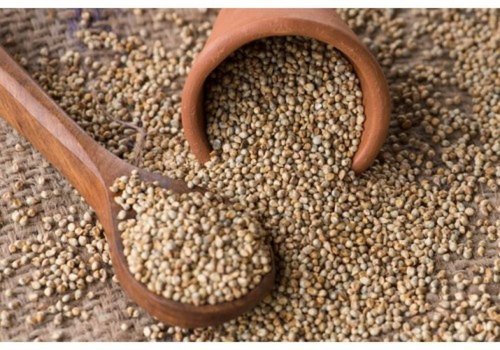
General Physical Description:
- Shape: Highly variable depending on the variety. Common classifications include ovoid (egg-shaped), globular (round), hexagonal, or lanceolate (pointed at one end and rounded at the other).
- Dimensions: Typically 3–4 mm in length and 2–2.5 mm in width.
- Weight: The average 1,000-seed weight is approximately 8 grams (ranging from 2.5 to 14g), which is much lighter than wheat’s 30–50g for the same count.
- Color: True to its name, many varieties have a pearly white or grey-blue However, they can also range through shades of pale yellow, golden-brown, and even deep purple or slate blue.
- Texture: The surface is generally smooth and slightly glossy. Unlike some other millets that have a loose “sack-like” hull, pearl millet is a “naked” caryopsis, meaning it has no outer husk when harvested.