
Yellow Maize
Specifications:
Component | Average Range (per 100g) | Technical Standard (14% Moisture) |
Starch (Carbohydrates) | 65% – 75% | High energy, primarily amylopectin and amylose. |
Crude Protein | 8.0% – 11.0% | Predominantly Zeins (40-50% of total protein). |
Crude Fat (Lipids) | 3.5% – 5.0% | Concentrated in the germ (rich in Linoleic acid). |
Moisture Content | 12.0% – 14.5% | Codex standard max is 15.5%. |
Crude Fiber | 2.0% – 3.0% | Mostly insoluble (hemicellulose and cellulose). |
Ash (Minerals) | 1.1% – 1.8% | Indicates mineral density. |
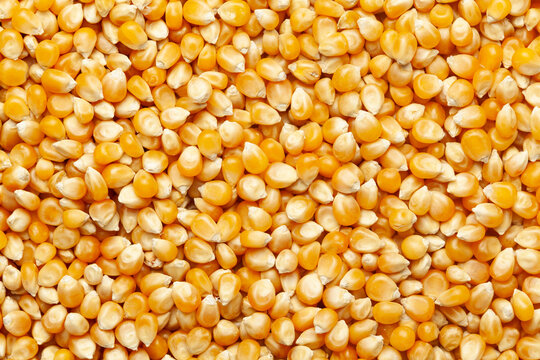
General Physical Description:
- Shape: Most yellow maize kernels are obovate or wedge-shaped (wider at the top and narrow at the base). Depending on the variety, they can be:
- Dent Corn: Features a distinct depression or “dent” at the crown (top) caused by the shrinking of soft starch during drying.
- Flint Corn: Rounded and smooth at the top with a hard, glassy outer layer.
- Dimensions: Significantly larger than other cereals, typically 8–12 mm in length and 7–10 mm in width.
- Weight: An average kernel weighs between 250 and 350 mg, making it nearly 10 times heavier than a wheat kernel.
- Color: The vibrant yellow to orange-yellow color comes from carotenoids (specifically lutein and zeaxanthin) located within the endosperm.
- Texture:
- Vitreous Endosperm: A hard, translucent yellow layer just beneath the pericarp.
- Floury Endosperm: A soft, white, opaque center.