
Sorghum
Specifications:
Component | Range (per 100g) | Average (Dry Basis) |
Moisture | 9.0% – 12.0% | Max 14.5% (Codex Standard) |
Protein | 7.0% – 15.0% | ~11.0% (Rich in Leucine) |
Starch (Carbs) | 60% – 75% | ~70% (High Resistant Starch) |
Fat (Lipids) | 2.0% – 5.0% | ~3.5% (mostly unsaturated) |
Crude Fiber | 1.0% – 3.0% | ~2.5% |
Ash (Minerals) | 1.1% – 2.5% | ~1.6% |
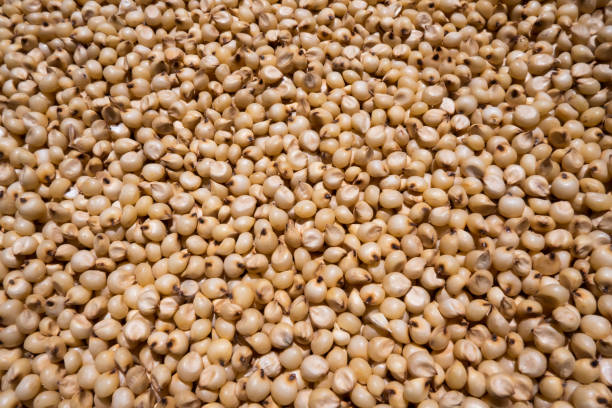
General Physical Description:
- Shape: Sorghum seeds are typically spherical or globe-shaped, though some varieties may be slightly flattened or pointed at the base (lanceolate). Unlike wheat, they do not have a crease (groove) on the surface.
- Dimensions: They generally measure 3–4 mm in diameter, making them slightly larger than pearl millet but smaller than a typical wheat grain.
- Weight: The 1,000-seed weight is usually between 25 and 30 grams, which is significantly heavier than pearl millet (~8g) but lighter than wheat (~40g).
- Common Colors: White, creamy yellow, bronze, orange, red, and deep brownish-purple.
- Texture: The surface is generally smooth and hard. Some varieties have a thin, translucent pericarp, while others have a thick, opaque coat that can contain high levels of tannins (common in darker, bird-resistant varieties).